
Copywriter Confessions: What we really want to say to you, but can’t
July 30, 2026
How to write a blog step-by-step – a beginner’s guide
September 3, 2026
Romey Norton | 4 min read | Wordsmiths Unlimited
I’m sure we’ve all heard the term ‘AI slop’ being thrown around. People are getting increasingly savvy when it comes to spotting content written or made by AI platforms. With telltale signs like em-dashes and words like ‘ensure’ and ‘actually’, we’re all beginning to recognise that AI has moved in and is now part of the furniture.
One of the biggest anxieties is that AI will get so good, our job as copywriters becomes obsolete. But let’s test that fear against the evidence: is AI actually getting better at writing? What on earth is this AI slop that everyone’s talking about? And how can we avoid it?
AI is a genuinely smart tool. But it can’t relate to your brand, your customers, or your business the way a human writer can, and that’s where the real value sits.
Why are people using AI to create content?
It’s no lie that humans have always used technology to help progress and make life easier. From the first ever motorcar to the microwave, we want things to improve our everyday lives by saving us time. Even during the Cold War, there were machines that would read and write, which helped people spy on their enemies. But these were only used by a select few. Now these ‘machines’ are available, a lot for free, to the masses.
AI’s marketing of saving you time and money is appealing and, arguably, winning. But we need to question if it does what it says on the tin. Google has said for years that it doesn’t penalise content for being AI-written; it judges everything against the same “who, how, and why” quality signals, whether a human or a machine typed it. But that’s not quite the same as saying AI content is safe.
Google’s spam updates have wiped whole sites from its index, and the pages caught in the crossfire are almost always the same kind: low effort, mass-produced, written to game the algorithm rather than help a reader. One SEO agency tested this directly. They generated a page with ChatGPT; it scored as 100% AI-written, and Google dropped it from the index entirely. They rewrote it as a human, and it was back in the top 10 within hours.
So, if you’re a small business, freelancer, or corporate churning out AI content to save time, the risk isn’t that Google bans AI – it’s that AI slop gets read as spam, and spam gets buried. And the cost of fixing that (in time, revenue, and reputation) can end up far higher than hiring a professional in the first place.
It’s also worth knowing you’re the one on the hook if any of it is wrong. Google has said it won’t accept liability for errors in its AI-generated content, and Germany’s government has followed suit – with the UK expected to move the same way. Translation: if your AI tool gets a fact wrong, that’s your problem, not theirs.
What is AI slop?
AI-slop is a widely used term for bad and unwelcome content. It’s usually low-quality and repetitive. I’ve seen at least six businesses on my LinkedIn page using the same poster to promote a service. Same layout, same font copy, same, same, same. And that’s very boring. I’ve also had it in my daily life, friends making hen-do posters and call-outs for their short films. It’s as dull as dishwater.
Most AI-slop is created for clicks, monetisation and speed. In 2025, the Guardian reported that AI-generated content was taking over YouTube’s fastest-growing channels. But Forbes has since suggested that 2026 needs to be the year of the “AI-slop purge”, and not for the reader’s sake, but for the models. If AI systems start training on AI-generated content instead of real human writing, quality degrades over time. It’s a bit like photocopying a photocopy: each generation gets a little blurrier than the last. That gives AI companies a direct commercial incentive, a need to protect their own product, and their valuation, to clean up the very content they helped create.
Real human copywriters won’t degrade the more we write. In fact, the opposite is usually true. Just saying.
Recently, LinkedIn announced they’re taking on the AI-slop battle by introducing an AI-slop button. This will allow you to report a post you feel is AI-slop, but as this post from Michael Guy says, there are both positives and negatives to this.
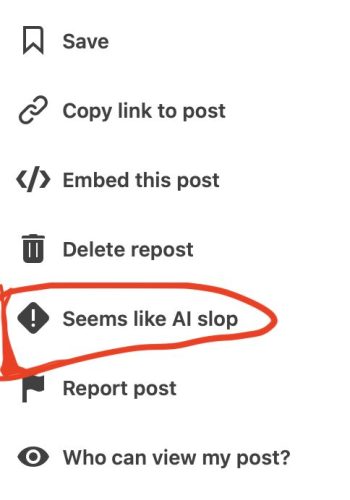
The platform’s algorithm rewards engagement regardless of source, so AI-generated content isn’t really worse than the human-generated noise we already scroll past. Guy points out that this feature conveniently provides LinkedIn free training data for its own AI ambitions, especially valuable given how poor its previous AI writing tool was. And he suggests we’re not actually good at spotting AI content, we will just flag anything that follows a recognisable pattern, which is why tools that “detect” AI writing often misfire on good human prose (Agatha Christie reportedly fails these checks).
He says the real cost of punishing lazy writing, not rewarding good structure, is that businesses doing genuinely good work with these tools are staying quiet, afraid of being publicly shamed for it.
It’s going to be a trend to follow to see if other sites decide to use this on their platforms with the aim of tackling AI-slop.
Is AI getting better at writing?
The short answer is yes and no. If you’re a copywriter with years of experience, your AI prompts will be more effective than others, and you’re better able to edit what it produces. But usually copywriters love to write, so likely won’t be using AI. We certainly don’t and have written down that commitment in our AI policy.
If you’re not someone who’s trained to write, AI probably will get you a decent enough piece of work for your website and/or socials. But will it perform how it’s supposed to? Most likely, no.
How can I avoid AI slop?
Well, unless you’re going to close all your socials down so you can’t see it, I think AI slop will always be there. Writing has never had to be perfect; it’s had to be human. Try to work with real people, read work by real humans, and that should help keep that AI slop away.
If money and time are tight and you feel that AI has become the solution to your needs, make sure your prompts are strong – give it a brilliant brief. And remember that AI should never produce the final product. It might give you a start, but you will need to edit what you’re given – and fact-check to make sure it hasn’t hallucinated any details.
Or you can use copywriters, like us here at Wordsmiths, to create compelling copy for your business.
When should I bring in a professional copywriter?
If your content hasn’t had a refresh in years, if your website isn’t bringing in the traffic, if your leads are down, then you most likely need some copywriters to help with your content strategy.
AI content without real expertise is a genuine business risk, and with more than 252 years of combined experience on our team, expertise is what we bring. We can help you stay out of the AI-slop and show up for yourself and your clients. Get in touch and let’s work together.